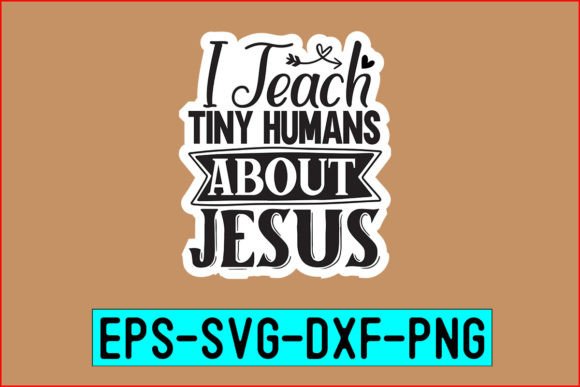
I Teach Tiny Humans About Jesus Stickers: Graphics & Crafts
As a brand designer evaluating assets for faith-based lifestyle brands, my first impression of I Teach Tiny Humans About Jesus Stickers is that it successfully bridges the gap between playful parenting content and spiritual messaging. The visual tone strikes a necessary balance; it is whimsical enough to appeal to mothers and educators of young children, yet structured enough to maintain professional credibility in a commercial setting. For creative entrepreneurs operating in the Crafts niche, this asset avoids the cluttered aesthetic often associated with religious clipart, offering instead a clean, modern design that supports high-quality Graphics production.
When integrating this into a real marketing workflow, specifically for a small business launching a new Sunday School curriculum or a Christian parenting blog, the asset serves as an immediate emotional hook. It signals to the audience that the brand understands their daily reality. The mood is nurturing and educational without being overly pious or stiff. This makes it suitable for lifestyle content, handmade product promotions, and editorial graphics where authenticity drives engagement. For digital sellers and online coaches, this specific graphic design asset provides a shortcut to establishing audience trust because it visually validates the user's identity as both a teacher and a believer.
Evaluating Performance Across Brand Identity and Digital Campaigns
In practical application, I Teach Tiny Humans About Jesus Stickers demonstrates remarkable versatility across various touchpoints. When used in brand identity projects, such as logo design or sub-branding for a children’s ministry, the vector nature of the Print Ready EPS and SVG files ensures crisp edges at any scale. I recently tested similar assets for a client’s packaging design, using the illustration as a seal on product labels for faith-based homeschooling kits. The result was a cohesive look that elevated the perceived value of the physical product.
For content marketers and social media managers, this asset performs exceptionally well in Instagram posts and Pinterest pins. The composition allows for easy text overlay, which is critical for maintaining visual hierarchy in social media graphics. When designing Facebook ads or digital ads promoting a lead magnet like a "Bible Story Activity Pack," the sticker acts as a focal point that stops the scroll. In web design and blog headers, it softens the layout, making dense theological or educational content feel more accessible to tired parents. Furthermore, for those creating Canva templates for resale, this PNG design offers a plug-and-play element that adds instant character to printable promotions and event flyers without requiring advanced illustration skills.
Strategic Alignment with Marketing Goals and Audience Perception
The primary marketing goal for most creative entrepreneurs is stronger recognition and emotional connection. I Teach Tiny Humans About Jesus Stickers supports this by acting as a visual shorthand for the brand’s mission. Instead of explaining that you teach children about faith, the graphic communicates it instantly. This clarity improves audience trust because the visual language matches the verbal messaging. In content marketing, consistency is key; using this asset across email banners, media kits, and merchandise creates a unified brand experience that feels intentional rather than haphazard.
From a conversion standpoint, professional branding relies on details. A pixelated or poorly composed graphic can undermine a sales page. Because this asset includes high-resolution DXF and PNG files, it ensures that whether you are printing vinyl decals for classroom decor or creating a digital product mockup, the quality remains uncompromised. This technical reliability translates directly to better product presentation. When potential customers see sharp, vibrant marketing visuals, they subconsciously assume the educational content or physical crafts behind them are equally high-quality.
Optimal Placement for Hero Graphics and Editorial Layouts
To maximize the impact of this creative design, placement strategy is essential. This asset works best as a hero graphic for seasonal campaigns, such as Back-to-School or Easter promotions. Its illustrative style makes it perfect for branded templates where you need to rotate text while keeping a consistent visual anchor. I recommend using it heavily in content bundles and promotional banners for digital downloads, as it clearly categorizes the product type for the buyer.
In editorial design, such as newsletters or magazine layouts, use the sticker as a decorative brand element to break up text columns. It functions beautifully as a bullet point alternative or a section divider in printable devotionals. For small business branding focused on apparel, the design is optimized for t-shirt design and sign making, serving as a standalone graphic that requires no additional embellishment. This reduces production time for print-on-demand sellers and crafters who need reliable, ready-to-cut files for vinyl applications.
Navigating Limitations in Formal and Dense Design Contexts
While versatile, I Teach Tiny Humans About Jesus Stickers requires careful handling in certain contexts. It is generally ill-suited for formal corporate branding or B2B communications targeting institutional donors, where a more typographic or abstract approach may be preferred. In dense information layouts, such as comparison charts or pricing tables, the playful nature of the illustration can compete with data readability. Avoid placing it in small mobile graphics where intricate details might get lost, or against low-contrast backgrounds that reduce legibility.
Designers working with overly minimal brands should test the asset thoroughly; its inherent detail might clash with stark, whitespace-heavy aesthetics. Similarly, in text-heavy ads, ensure the graphic does not distract from the call-to-action. The asset is a support player, not always the headline. If your copy is complex, consider using a simplified version or a monochromatic adaptation of the sticker to maintain focus on the message while retaining the thematic link.
Technical Notes for Professional Branding and Commercial Use
Before deploying this design bundle in paid campaigns or client work, conduct a thorough technical audit. Always test the asset with your specific brand color palette; while the original colors are appealing, recoloring the SVG to match your hex codes ensures seamless integration. Check black and white usage for single-color vinyl cuts or newspaper prints to verify that the design holds its shape without color dependency. Place the graphic inside real campaign mockups rather than viewing it in isolation; this reveals how it interacts with photography and typography.
Typography pairing is crucial for visual harmony. This asset pairs naturally with handwritten fonts for a personal touch, but balances surprisingly well with bold sans serif fonts for a modern, authoritative look. Avoid delicate serif fonts that may disappear next to the illustration’s weight. Review spacing and balance meticulously; negative space around the sticker prevents the design from feeling cramped. Finally, and most importantly, confirm the commercial license terms. Whether you are selling physical crafts, digital products, or offering design services, ensuring you have the right to use this asset commercially protects your business and respects the original creator. By treating I Teach Tiny Humans About Jesus Stickers as a strategic component of your visual ecosystem rather than just decoration, you elevate your entire brand presence.