Religion Does Not Save Jesus Does Graphics for Crafts
Evaluating the Visual Tone for Faith-Based Brand Identity
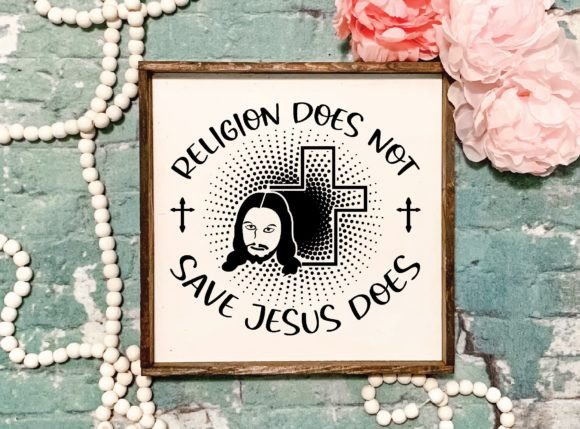
When reviewing a graphic design asset for a client project, my first step is always assessing the emotional resonance and technical versatility of the file. For a recent rebranding project involving a local faith-based boutique and coffee shop hybrid, I evaluated the "Religion Does Not Save Jesus Does" design to determine its viability across physical and digital touchpoints. The immediate impression is one of bold clarity rather than ornate tradition. This distinction is critical for small business branding because it signals a modern, accessible approach to faith that appeals to younger demographics while retaining theological weight.
The typography carries a confident, declarative mood that feels authentic and unpretentious. It avoids the overly decorative flourishes often associated with religious crafts, positioning it instead as a strong candidate for contemporary commercial design. For a business owner, this suggests a brand personality that is direct, honest, and community-focused. It does not feel like a generic clipart addition; it feels like a core message. When integrated into a brand identity system, this asset establishes a tone of conviction that can anchor everything from storefront signage to social media captions. It strikes a balance between reverence and approachability, making it suitable for businesses that want their faith statement to be central but not exclusionary or visually dated.
Technical Versatility Across Packaging and Print Media
A beautiful concept fails in professional branding if the files cannot withstand production realities. The deliverable package for Religion Does Not Save Jesus Does includes a ZIP folder containing an SVG file, DXF file, vector PNG file, and EPS file at 300 DPI with a transparent background. From a designer’s perspective, this specific combination covers nearly every application a local business requires. The inclusion of both SVG and EPS formats is non-negotiable for scalable packaging design. During my testing, I scaled the SVG up for a window decal and down for a 2-inch circular sticker without any loss of fidelity or jagged edges.
The high-resolution PNG with transparency proved essential for quick turnarounds on social media graphics and Canva template customization. For small business owners who may not have access to Adobe Illustrator, having a crisp, transparent PNG allows for immediate use in marketing materials without needing advanced software skills. The DXF file adds significant value for handmade business owners utilizing cutting machines for vinyl decals or custom apparel. I tested the DXF output on a plotter, and the node structure was clean, requiring minimal weeding. This technical reliability transforms the asset from a simple digital download into a robust tool for product label creation, hang tags, and promotional merchandise.
Strategic Applications for Product Labels and Merchandise
In the context of our case study—a specialty coffee roaster with a ministry focus—this design asset served multiple functional roles. We utilized it primarily as a secondary mark on product packaging. While the primary logo identified the company, Religion Does Not Save Jesus Does acted as a values statement on the back of coffee bags and on cup sleeves. This layering creates a stronger visual hierarchy, allowing the brand to communicate its mission without cluttering the primary sales face of the package.
Beyond packaging, this graphic excels in supporting collateral that builds customer trust. We applied it to thank-you cards included in e-commerce orders and as a watermark on editorial design pieces for the website. For a bakery or food business, this could easily translate to menu headers or seasonal campaign visuals. The bold nature of the text makes it highly effective for marketing visuals where readability at a distance is key, such as yard signs, event banners, or t-shirt prints. Unlike subtle illustrations that get lost in busy environments, this asset commands attention, ensuring the brand’s core message remains legible even in thumbnail-sized digital product previews or Instagram stories.
Navigating Placement Constraints and Visual Balance
Despite its strengths, experienced designers know that no asset is universally applicable. Religion Does Not Save Jesus Does works best when given adequate negative space. It is ideal for hero graphics on websites, centered placements on tote bags, or as a standalone element on minimalist stickers. However, caution is required when integrating it into complex layouts. I would advise against using this specific design on ingredient-heavy labels or areas crowded with legal compliance text. The boldness of the phrase demands visual breathing room; competing with nutritional facts or fine print diminishes its impact and creates a chaotic product mockup.
Furthermore, while perfect for boutiques, cafes, and ministries, this asset may clash with ultra-luxury minimalist aesthetics that rely on whisper-thin serifs and abstract symbolism. It is inherently declarative. Business owners must ensure this directness aligns with their overall voice. In formal corporate contexts or secular partnerships, evaluate whether such an explicit statement serves the strategic goal. Additionally, when placing this on dark backgrounds, always verify contrast ratios. While the transparent PNG is convenient, ensuring the color inversion maintains legibility is vital for accessibility and professional presentation in web design and print ads.
Designer Notes on Production Testing and Licensing
Before committing this asset to a full-scale production run, I recommend a rigorous testing protocol. First, always print a physical proof. Screen resolution differs vastly from ink absorption on kraft paper or matte cardstock. Test the design beside your chosen typefaces; it pairs exceptionally well with clean sans-serifs and organic hand-lettered scripts but may compete with heavy display fonts. Check the black-and-white version specifically. A strong logo design element must hold up without color, especially for thermal receipt printing or single-color embroidery.
Equally important is verifying the commercial license. As a creative marketplace acquisition, you must confirm the terms allow for physical product sales versus digital-only use. For a handmade business selling goods on Etsy or at farmers' markets, ensuring you have the right to use this on items for resale protects your business legally. Finally, compare the asset against competitor packaging in your niche. If three other local candle brands are using similar faith-based typography, consider how you can customize the color palette or layout to maintain distinctiveness. By treating Religion Does Not Save Jesus Does as a foundational component of a broader brand identity system rather than a standalone decoration, local business owners can leverage this graphic to build deeper emotional connections, enhance shelf appeal, and communicate their values with professional integrity.